
Replacement Cost vs. an Agreed Roof Payment Schedule in Arkansas
Most homeowners assume that a policy saying “replacement cost” means a brand-new roof after a storm. Arkansas roofs are settled one of two ways, and which one you have is already printed in your endorsements.
Short Answer
In Arkansas a roof claim is settled one of two ways: at replacement cost, or under an Agreed Roof Payment Schedule — a grid of percentages by roof age and material that the carrier files with the state and prints in your policy. Age seven is the earliest a mandatory schedule may attach. Which one you have is in your endorsements right now.
Roof coverage has quietly become the biggest change in Arkansas homeowners insurance in the last decade. Hail, straight-line wind and the cost of roofing have all moved in the same direction, and carriers responded by getting far more precise about how a roof claim is paid.
The result is that your roof is settled under one of two methods, written into an endorsement rather than onto the front of your declarations page. Most homeowners find out which one they have after they file. By then the choice has already been made for them.
You will also see actual cash value described online as a third option. Set it aside. Arkansas roofs are not settled on open-ended depreciation. If your own policy applies actual cash value language to roof surfacing, that is worth reading with someone — it is the exception, not the norm, and it is the kind of thing that should be caught at renewal rather than at a claim.
The Two Ways an Arkansas Roof Claim Is Paid
Replacement cost
Replacement cost is written to pay what it costs to replace the damaged roofing with similar new materials, subject to your deductible, your limits and the conditions of the policy. It is usually the strongest position for a newer roof.
It does not mean every roof claim ends in a new roof. The loss still has to be caused by a covered peril, and the claim is still evaluated against the roof’s condition before the storm, its maintenance history, prior repairs, and the exclusions and endorsements on the policy. On an older roof, that evaluation is where the argument happens.
An Agreed Roof Payment Schedule
A schedule sets the settlement in advance. The policy carries a grid of percentages by roof age and roofing material, and the percentage that applies to your roof is readable the day the policy is issued — not calculated by an adjuster after the storm. The grid is filed with the Arkansas Insurance Department and approved before a carrier may use it.
That is the trade. A schedule can pay less than full replacement on an older roof. What it gives back is a number you can know in advance, compare between carriers, and plan around.
| Replacement cost | Agreed Roof Payment Schedule | |
|---|---|---|
| How the amount is set | Determined after the loss, against the policy conditions | Set in advance by a filed grid of age and material |
| When you learn the number | After the claim is adjusted | The day the policy is issued |
| Strongest for | Newer, well-maintained roofs | Older roofs, and anyone who wants a predictable figure |
| The catch | An older roof invites a dispute about whether the storm or the wear caused the damage | The scheduled percentage can be well under full replacement on an older roof |
| Where it lives | The policy form | An endorsement, usually titled around roof loss settlement or roof surfacing |
The question that actually matters
“Replacement cost” sounds better, and on a newer roof it usually is. On an older roof the useful question is not which label is stronger but which one will produce a number you can live with, and do you know what that number is today. One of these methods tells you before the storm. The other tells you afterward.
Where the Age-Seven Rule Really Comes From
This is the point almost every article gets backwards, including several that outrank this one.
Arkansas does not require replacement cost for the first seven years. What the rule sets is a floor on timing: age seven is the earliest a mandatory Agreed Roof Payment Schedule endorsement may attach to a replacement cost policy for wind and hail losses. A carrier may write a policy with no schedule at all, or attach one only at a later age. What it may not do is start the mandatory endorsement earlier.
Many filed schedules do pay in full through the early years, and that is why the pattern looks like a state guarantee from the outside. It is not one. It comes from the carrier’s grid, and a grid is a competitive decision that differs between companies. Reading the age-seven rule as a promise of replacement cost is how homeowners end up surprised in year eight.
What this means in practice
If someone tells you Arkansas guarantees a new roof for seven years, they have the rule inside out. The state sets the earliest a schedule may begin. Everything else — whether a schedule attaches at all, at what age, and at what percentage — is in the filing your carrier made and in the endorsement on your policy.
What a Schedule Looks Like
Schedules follow a shape rather than a standard. The percentage starts high, steps down as the roof ages, and runs on a different curve for each roofing material — composition shingle, metal, slate, concrete or clay tile and wood shake do not depreciate alike, and the grid reflects that. Two carriers looking at the same fifteen-year-old shingle roof can land in genuinely different places.
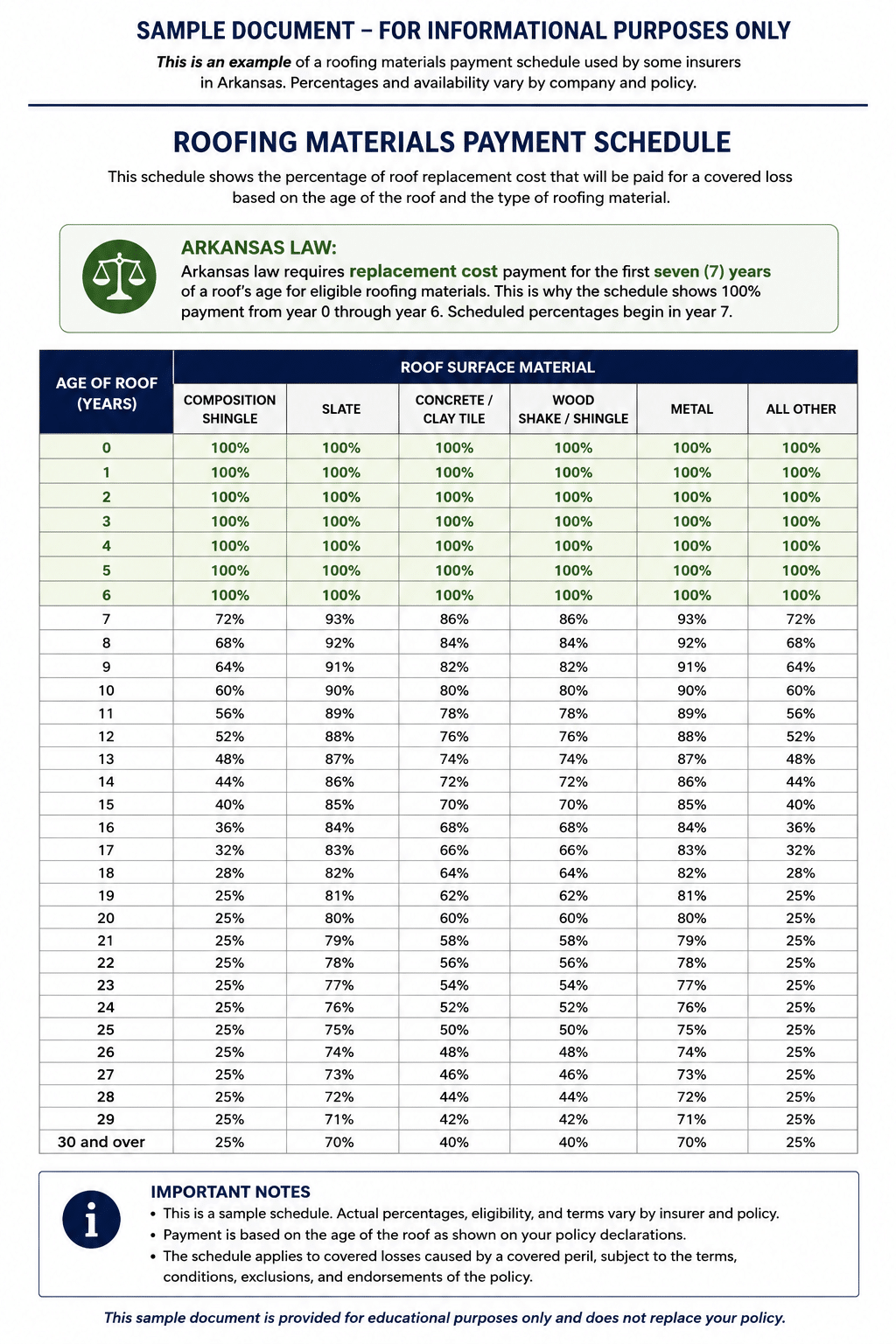
Illustration only. This is a recreation showing what a schedule looks like so that you can recognize one in your own policy. It is not any carrier’s filing, and no number on it applies to you. Yours is in your endorsement.
The reason to look at one is recognition. A homeowner who has seen a grid knows what they are holding when they find one in their policy. A homeowner who has not usually reads past it.
How to Find Out Which One You Have
Fifteen minutes with your policy settles this permanently.
- Open the endorsement list, not the declarations page. The dec page shows your dwelling limit and your deductible. The roof settlement language almost always lives in an endorsement behind it.
- Look for the words, not the marketing. Roof loss settlement, roofing material payment schedule, windstorm or hail loss to roof surfacing. Any of those means a schedule is attached.
- Find the grid and your row. If a schedule is attached there will be a table of percentages. Cross your roof’s age against your roofing material.
- Check the roof age the carrier has on file. Under a schedule the age on file drives the percentage, and an incorrect installation year is worth correcting before a storm rather than after one.
- Convert your wind and hail deductible into dollars. On many Arkansas policies it is a percentage of the dwelling limit rather than a flat amount, and it comes off the settlement either way.
- Ask what changes at the next age band. If your roof is about to cross into a lower band, that is a reason to shop the renewal rather than let it roll.
The deductible is part of this arithmetic
Whichever settlement method applies, your wind and hail deductible comes off the number. If it is written as a percentage of your dwelling limit, most homeowners have never converted it into an actual figure. Our guide to the Arkansas wind and hail deductible is the companion to this one, and the two numbers only mean something together.
Two Roofs, Two Right Answers
| A five-year-old architectural shingle roof | An eighteen-year-old roof | |
|---|---|---|
| What happens in a hailstorm | Widespread covered damage on a roof with most of its life left | Covered damage on a roof near the end of its service life |
| Where replacement cost lands | Usually the strongest position, subject to the policy conditions | The likeliest place for a dispute about wear against storm |
| Where a schedule lands | Often paying in full anyway, so the label matters less than it seems | A lower figure, but one you knew before the storm and could plan for |
| The practical move | Confirm no schedule attaches earlier than you expect | Know the percentage, know the deductible, and decide whether replacing the roof changes what the market will offer you |
Questions to Ask Before You Renew
The right time to understand roof coverage is before a storm. These are the ones worth asking, of your current carrier or of anyone quoting you:
- Is my roof settled at replacement cost or under a schedule? Do not rely on what you were told when the policy was written; verify it in the current endorsements.
- If a schedule attaches, at what age does it start and what percentage applies to mine?
- Does the policy limit cosmetic damage? Some do, particularly on metal roofs, and the definition varies.
- Is my wind and hail deductible a flat amount or a percentage? If it is a percentage, what is that in dollars?
- How does the policy handle matching? Shingles that cannot be matched to the existing roof are a common source of partial-payment arguments.
- What roof age does the carrier have on file, and is it right?
- Would replacing the roof change what is available to me? Sometimes it opens options that are closed today, and sometimes it does not — worth knowing before spending the money.
What People Believe, and What the Policy Says
| The belief | What the policy says |
|---|---|
| Replacement cost always means a brand-new roof | It is still subject to the terms, conditions, exclusions, endorsements and deductible, and to whether a covered peril caused the damage |
| A payment schedule is always the worse deal | On an older roof a published percentage can be more useful than replacement cost language that turns into an argument — and many schedules pay in full in the early years anyway |
| A schedule is just actual cash value under another name | They work differently. Actual cash value is open-ended depreciation calculated after the loss; a schedule is a set of percentages filed with the Arkansas Insurance Department and approved before use. Arkansas roofs are not settled on open-ended depreciation |
| An old roof cannot be insured | Many carriers continue to write older roofs using different underwriting rules, settlement schedules or deductibles |
| Every company handles roofs about the same way | Settlement provisions, scheduled percentages, cosmetic limitations, matching language and deductibles all differ by company, which is the entire reason to compare on something other than premium |

Ask Cribby about your roof coverage
Cribby is Cribb Insurance Group’s AI assistant. Ask a question in plain English, or tap one to start:
Frequently Asked Questions
Does Arkansas require replacement cost on roofs?
No. What Arkansas sets is a floor on timing: age seven is the earliest a mandatory Agreed Roof Payment Schedule endorsement may attach to a replacement cost policy for wind or hail losses. Many filed schedules do pay in full through the early years, but that comes from the carrier’s own filed grid rather than from a state mandate. Your policy form and its endorsements control.
What happens after my roof turns seven years old?
Many Arkansas homeowners policies begin settling wind and hail roof losses according to the filed payment schedule at that point. The scheduled percentage varies by roofing material and by carrier, which is why the same roof can be worth meaningfully different settlements at different companies.
Is replacement cost always the better coverage?
It often is for a newer roof. For an older roof a schedule can be more useful, because the settlement percentage is published in the policy before a loss rather than argued about afterward. The honest answer depends on the age of the roof and on what you want to be certain of.
Is an Agreed Roof Payment Schedule the same as actual cash value?
No, and Arkansas roofs are not settled on actual cash value. Actual cash value is open-ended depreciation an adjuster calculates after a loss from age and condition. A schedule establishes percentages in advance by roof age and material, filed with and approved by the Arkansas Insurance Department before a carrier may use it. If your policy applies actual cash value language to roof surfacing, have it reviewed.
Can my insurance company deny a roof claim because the roof is old?
Age by itself does not decide it. The claim is evaluated on the cause of loss and on the terms, conditions, exclusions and endorsements of the policy. Age matters to the extent that it affects whether the damage came from the storm or from wear, and to what a schedule pays.
Does hail damage always mean a new roof?
Not necessarily. Whether a roof is repaired or replaced depends on the extent of the covered damage, the roofing material, local building requirements and the settlement provisions in the policy.
What counts as cosmetic roof damage?
Cosmetic damage generally means damage that affects how the roof looks without meaningfully affecting its ability to shed water and do its job. Some policies contain cosmetic damage limitations or exclusions, particularly on metal roofs, and the definition is not identical between them.
Should I replace my roof before changing insurance companies?
It depends on the age and condition of the roof. Replacing an aging roof can open up coverage and carriers that are closed to it today, but not always, and it is an expensive move to make on an assumption. It is worth having someone check what the market would offer either way before you spend the money.
How do I find out which settlement method I have?
Read the endorsements rather than the declarations page. Look for roof loss settlement, roofing material payment schedule, or windstorm or hail loss to roof surfacing. If a schedule is attached there will be a grid of percentages by roof age and material, and the limiting language will be in that endorsement rather than on the front page.
Can Cribb Insurance compare roof coverage across companies?
Yes. As an independent agency representing more than forty carriers, we compare roof settlement methods, scheduled percentages, cosmetic and matching language, deductibles and endorsements side by side, rather than comparing premiums and hoping the coverage matches.
Make Cribb Insurance Your Google Preferred Source
Get straightforward Arkansas insurance answers from a trusted local agency.
Add Cribb Insurance as a Preferred SourceFind Out How Your Roof Is Covered Before the Next Storm
Send us your policy and we will tell you which settlement method applies, what percentage your roof sits at if a schedule is attached, what your wind and hail deductible is in dollars, and how that compares across more than forty carriers. It takes one document and it is a great deal easier to do now than during a claim.
Disclaimer: This article is general information and is not insurance, legal, tax or financial advice, and it is not a substitute for the terms of your own agreements or policies. Roof settlement provisions, filed schedules, percentages, deductibles, endorsements and underwriting guidelines vary by insurance company and by policy, and Arkansas rules may change. The sample schedule shown is an illustration and is not any carrier’s filing. Nothing here is a coverage determination or a prediction of any claim outcome; the policy actually issued to you governs, and an agency routes and follows a claim rather than adjusting one. Coverage is set by the insurance company and is subject to the terms, conditions and exclusions of the policy actually issued to you, which controls in every case. Cribb Insurance Group Inc is an independent insurance agency licensed in Arkansas, Oklahoma, Missouri and Texas. Cribb Insurance Group Inc is an independent insurance agency, not an insurance company. The insurance company carries the risk and files the rates, and any claim payment comes from the insurance company and not from the agency. Where Cribb binds coverage or issues a policy, it acts on a carrier’s behalf and within the authority that carrier grants, and the policy actually issued controls in every case. Reviewed 2026-08-09; insurance law and carrier filings change, and this article may not describe the current position after that date. Coverage cannot be bound, changed or cancelled through this website, by email, by social media or by voicemail. No coverage is in force until Cribb Insurance Group Inc or the insurance company confirms it in writing. Cribb Insurance Group Inc, 1601 SW Regional Airport Blvd, Bentonville, AR 72713 · (479) 286-1066 · service@cribbinsurance.com.