
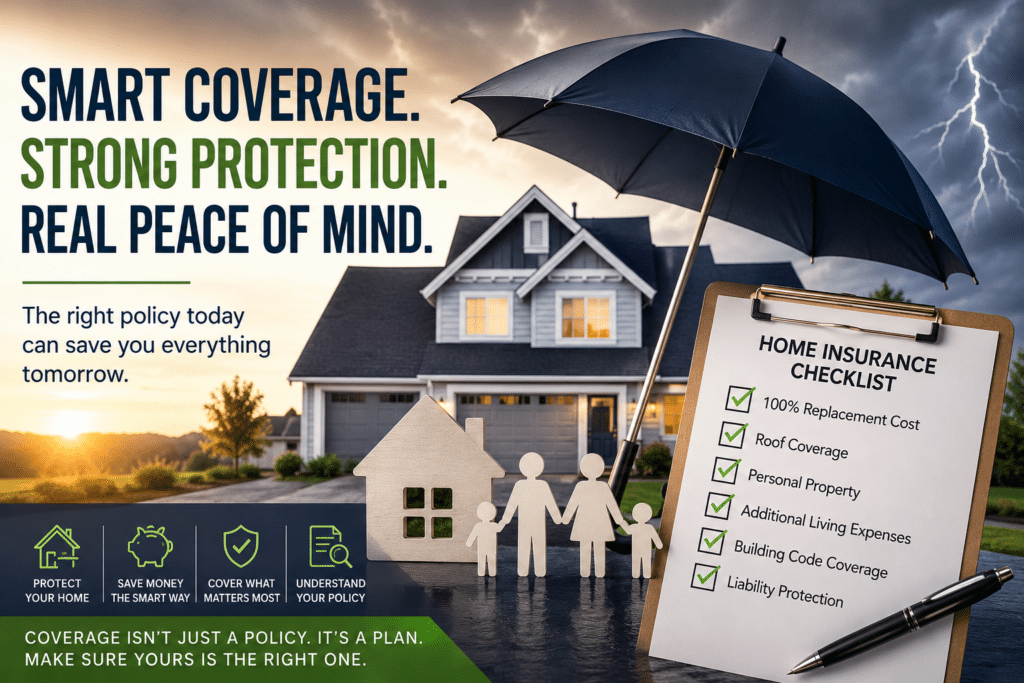
Most Homeowners Aren’t Overpaying for Insurance — They’re Buying the Wrong Policy
When people shop for home insurance, they usually focus on one thing: the price.
That sounds reasonable until a major storm, tornado, fire, or hail claim happens and they discover the “great deal” they purchased doesn’t actually cover what they thought it did.
As an independent insurance agency representing multiple companies, we see this every day. The truth is that most homeowners don’t fully understand what they’re buying because many of the most important coverages are hidden in policy forms, endorsements, exclusions, and settlement terms that never appear on the quote sheet.
Two policies can look almost identical on paper while providing dramatically different claim outcomes.
That’s why smart insurance shopping isn’t about finding the cheapest quote. It’s about understanding what’s actually being covered — and what isn’t.
The good news? You can often save $1,000 or more per year while still protecting yourself properly if you know what questions to ask.
The Biggest Mistake Homeowners Make When Comparing Insurance Quotes
The largest mistake homeowners make is assuming all insurance policies are basically the same.
They aren’t.
Many carriers and agencies reduce pricing by quietly changing coverage structures behind the scenes. Consumers often believe they’re comparing identical policies when they’re actually comparing completely different levels of protection.
Here are some of the most common ways policies get stripped down to create lower pricing:
- Underinsuring the home’s rebuilding cost
- Removing extended replacement cost coverage
- Excluding guaranteed replacement cost options
- Changing personal property from Replacement Cost to Actual Cash Value
- Reducing Additional Living Expense coverage
- Removing building code coverage
- Adding restrictive roof settlement terms
- Including wear-and-tear clauses that may deny roof claims
Most homeowners never notice these differences because many of them don’t appear clearly on the declarations page or quote summary.
That lower premium may not actually represent better pricing. It may simply represent less protection.
Why Cheap Insurance Can Become Extremely Expensive
We saw this firsthand during the devastating 2024 tornado outbreaks in Bentonville and Rogers, Arkansas.
Many homeowners who purchased low-cost policies from large national carriers discovered after the storm that they didn’t have enough coverage to rebuild their homes or replace their belongings.
Some learned:
- Their dwelling limits were too low
- Their policy capped rebuilding costs
- Their belongings were depreciated
- Their roof coverage had major limitations
- Their additional living expense coverage was insufficient
Unfortunately, these problems are usually discovered after a catastrophic loss — not before.
Insurance only feels expensive until you need it.
The Difference Between “Cheap” and “Smart” Insurance
There’s nothing wrong with wanting to save money.
In fact, there are legitimate ways to reduce premiums significantly without putting yourself at financial risk.
But there’s a major difference between:
- lowering unnecessary costs, and
- stripping away critical protection
A smart insurance strategy focuses on protecting against catastrophic financial loss.
You should always ask yourself:
“If my home were completely destroyed tomorrow by a tornado or fire, would this policy actually rebuild my home and replace my belongings?”
That question matters far more than saving a small amount on monthly premiums.
The Best Ways to Save $1,000+ on Home Insurance
1. Bundle Your Policies
Bundling remains one of the largest money-saving opportunities available.
Many consumers know about bundling home and auto with the same carrier. What many people don’t realize is that independent agencies can sometimes create bundled discounts even across multiple carriers while still keeping everything managed under one agency.
That flexibility can create substantial savings opportunities while still allowing better policy customization.
2. Increase Your Deductible Instead of Reducing Coverage
One of the smartest ways to lower premiums is increasing deductibles while keeping strong protection in place.
In many cases, it’s far better to:
- keep extended or guaranteed replacement cost coverage
- maintain strong property protection
- preserve building code coverage
…while carrying a higher deductible.
Insurance should primarily protect against catastrophic losses — not necessarily every small claim.
3. Improve Home Updates
Carriers reward reduced risk.
Major updates that often help reduce premiums include:
- New roofs
- Updated electrical systems
- Plumbing upgrades
- HVAC replacements
- Security systems
Some carriers value updates more heavily than others, which is why carrier selection matters.
4. Understand How Credit Impacts Insurance
Most consumers don’t realize how heavily insurance pricing can depend on credit.
Some carriers place much greater emphasis on insurance scores and credit history than others.
An independent agency can often help match consumers with companies that fit their overall profile better rather than forcing everyone into a one-size-fits-all rating structure.
5. Be Careful With Frequent Claims
Filing claims every time a storm appears on the weather radar can eventually hurt your long-term insurability.
Insurance companies track claim frequency closely.
Homeowners who repeatedly file small or questionable claims may eventually:
- face higher premiums
- lose eligibility with preferred carriers
- become harder to insure
Insurance companies want to insure responsible risks — not homeowners constantly looking for payouts.
That doesn’t mean you shouldn’t file legitimate claims. It simply means homeowners should think strategically and understand the long-term impact of claim activity.
Roof Coverage: One of the Most Misunderstood Parts of Home Insurance
Roof coverage is one of the biggest areas where policies differ.
Many homeowners hear the phrase “Replacement Cost Roof Coverage” and assume that means full replacement under all circumstances.
That’s not always true.
Some policies include wear-and-tear clauses that may allow the carrier to deny claims if the roof is considered beyond its expected lifespan.
In some situations, a scheduled roof settlement may actually provide a more predictable outcome than a policy advertising replacement cost coverage with restrictive conditions hidden inside the contract.
These details matter enormously during hail and storm claims.
Homeowners should ask:
- Does the carrier do full roof replacements or partial repairs?
- How many hail hits per square trigger replacement?
- Can wear-and-tear language void coverage?
- What happens if the roof is older?
These are real-world claim questions — not marketing questions.
Questions Every Homeowner Should Ask Before Buying a Policy
Before purchasing home insurance, homeowners should ask:
Do you offer 100% extended replacement cost or guaranteed replacement cost?
Is my personal property covered at Replacement Cost or Actual Cash Value?
Does the policy include building code coverage?
How much Additional Living Expense coverage is included?
How does the carrier handle hail claims and roof replacements?
Does the carrier replace the full roof or only damaged sections?
Could roof age or wear-and-tear clauses affect claim approval?
What endorsements or exclusions are not shown on the quote sheet?
These questions alone can completely change the quality of the policy you purchase.
The Problem With Buying Insurance Like a Commodity
Shopping for insurance purely by price is similar to buying a car based only on the sticker price.
Imagine test-driving a fully loaded vehicle with premium features — then unknowingly purchasing the base model with none of those options because you focused only on the monthly payment.
That’s what happens with home insurance every day.
Many carriers offer multiple tiers of policies:
- stripped-down versions
- mid-level packages
- premium protection options
Consumers often think they’re comparing identical products when they’re not even close.
Why Independent Agencies Matter
One advantage of working with an independent agency is flexibility.
If a consumer wants maximum protection, we have carriers and policy structures designed to protect against catastrophic financial loss.
If a consumer’s primary concern is achieving the lowest possible premium, there are products designed for that as well.
Our job is not to force people into one option.
Our job is to help consumers understand what they’re buying so they can make informed decisions based on their own financial goals and risk tolerance.
Final Thoughts: Insurance Should Protect Your Financial Future
Home insurance is not just another monthly bill.
For most families, their home is their largest financial asset.
The goal should never be to simply buy the cheapest policy possible. The goal should be:
- protecting your ability to rebuild
- protecting your financial stability
- protecting your family from catastrophic loss
The right policy can save you thousands during a claim.
The wrong policy can cost you hundreds of thousands after a disaster.
Need Help Comparing Policies?
If you’d like a professional review of your current home insurance policy or quotes you’ve already received, our agency can help you compare coverage differences — not just pricing differences.
You can also use our online comparison tool at:
coveragecompare.cribbinsurance.com
Or contact our agency directly for a personalized policy review and quote comparison.